
Brewster County Court Records After a Jail Arrest
The local sequence starts with an arrest by the Brewster County Sheriff's Office, Alpine Police Department, DPS, federal or park authorities, or another law-enforcement agency. If the person is accepted into local custody, Brewster County Jail creates the booking record at 307 W. Sul Ross Ave. After that, Texas first-appearance rules require the arrested person to be taken before a magistrate without unnecessary delay for warnings, rights, and bail questions. The court records after a jail arrest begin to matter when prosecutors decide what charges to file and the appropriate court receives the case.
Brewster County uses different offices for the jail side and the court side. For custody, booking confirmation, or a jail record request, start with Brewster County jail inmate records. For booking photos, use the separate Brewster County jail mugshots path because no official public mugshot gallery was located. The court record is different: it tracks the filed charge, case number, calendar setting, motion practice, disposition, sentence, and any later record restriction.
The District Clerk page says Sarah Fellows Martinez supports the 394th Judicial District Court and is the custodian of court pleadings and papers in civil and criminal causes. That makes the District Clerk the central local office for district-court criminal records. Felony prosecution is handled by Ori T. White, the 83rd District Attorney, whose district includes Brewster, Pecos, Jeff Davis, and Presidio Counties.
District Clerk Records for 394th District Court
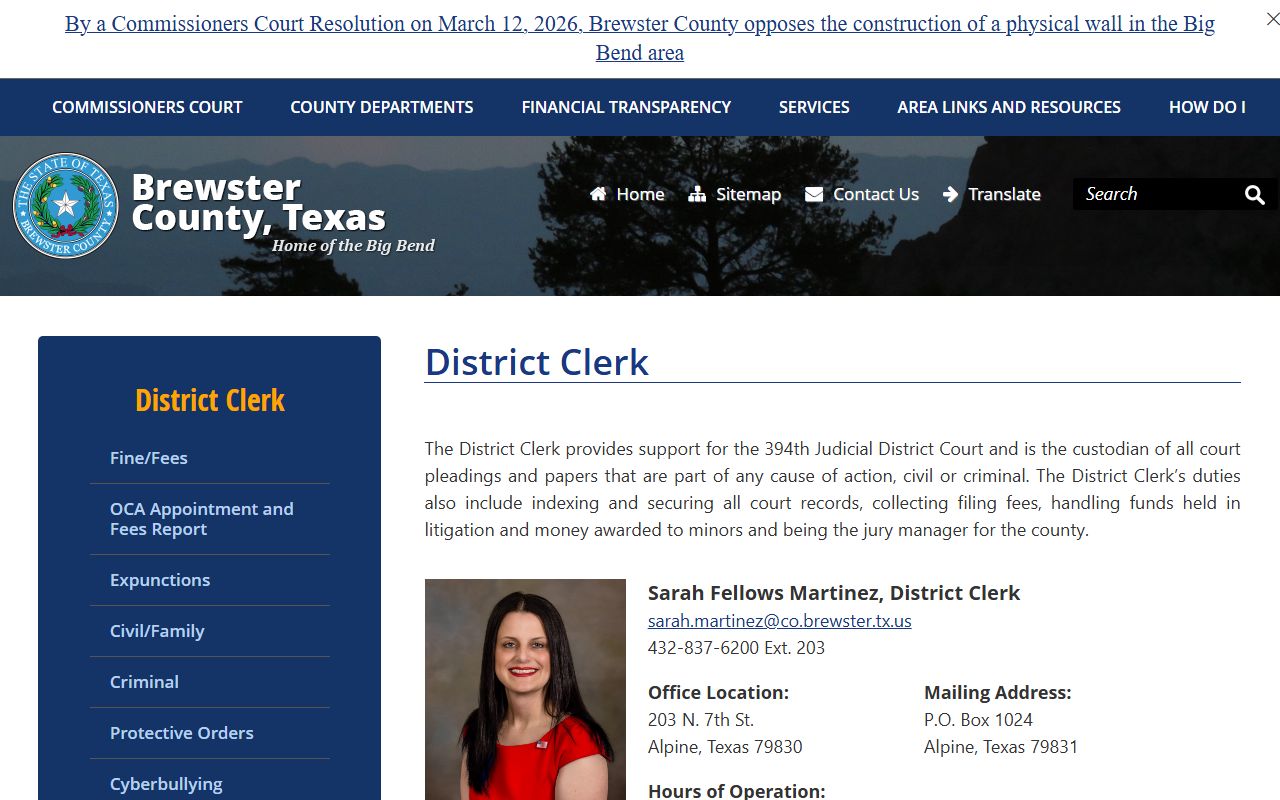
Brewster County's District Clerk is Sarah Fellows Martinez. The office is at 203 N. 7th St., Alpine, Texas 79830, with mailing to P.O. Box 1024, Alpine, Texas 79831. The phone number is 432-837-6200 Ext. 203, and the listed email is sarah.martinez@co.brewster.tx.us. Published office hours are Monday through Friday, 8:30 AM to 12:00 PM and 1:00 PM to 5:00 PM.
The Brewster County District Clerk page is the official local source for the clerk contact details, 394th District Court support, and links to iDocket tools.
Use the clerk office when a calendar search is not enough, when a filed document is needed, or when the case level is unclear after a jail arrest. A clerk cannot give legal advice, but the office can route requests for existing records and clarify whether a district criminal file is held there.
How to Find Court Records After an Arrest
The Brewster County court-calendar path is iDocket. It is useful for settings and case-number checks, but it should not be confused with a jail roster. The jail may confirm that a person was booked, while the court calendar shows where a filed case is scheduled. If the person was recently arrested, the court record may lag behind the booking event because the prosecutor still has to review the arrest papers and file the case.
- Start with the booking facts. Get the full name, date of birth if known, arrest date, booking date, arresting agency, and any charge or warrant number from the jail phone line or a written request.
- Decide which court level is likely involved. Felony matters are tied to the 83rd District Attorney and the 394th District Court record system. Lower-level matters may route through county, justice, or municipal courts.
- Open the iDocket court calendar and search by case number if one is known. If not, use date and attorney fields when those are available.
- Read the case caption, filed charge, court setting, and status carefully. A setting does not prove guilt and does not always mean the person is still in custody.
- Contact the District Clerk for filed documents or older criminal records that do not appear through the calendar view.
The Brewster County iDocket court calendar shows the search interface used for district and county calendar filtering.
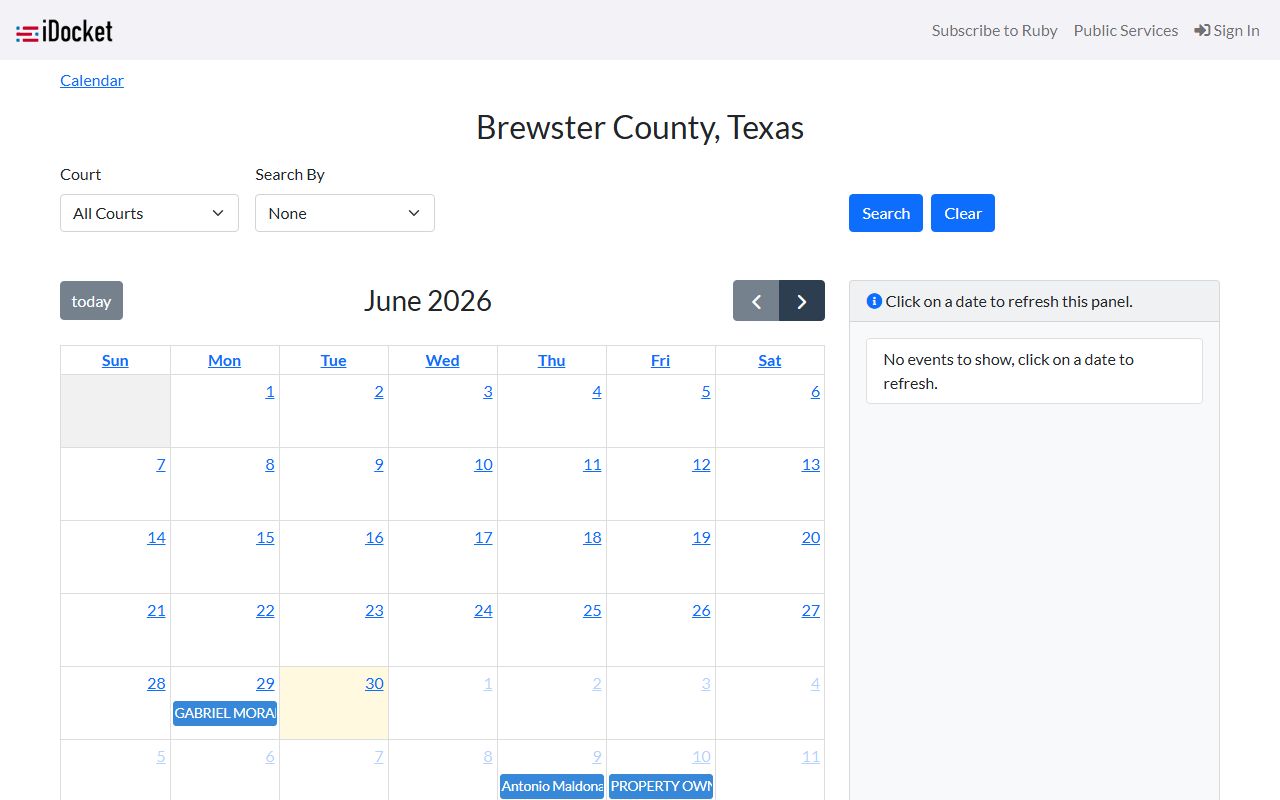
The calendar is a practical place to check hearings after an arrest, but the District Clerk and the court remain the better source for exact, current filed-record questions. iDocket calendar information can also be tentative, so a same-day hearing should be confirmed with the clerk.
Court Calendar Search Fields
The iDocket calendar gives several search paths. A case-number search is the cleanest route after a filed case exists. Attorney and date searches can help when the case number is not known, but they require more careful review because calendar results may include unrelated cases.
| Field Label | Type | Required | Options / Format Notes |
|---|---|---|---|
| Court | Dropdown | Optional | All Courts, All District Courts, All County Courts, County Court, or 394th District Court. |
| Search By | Dropdown | Optional | None, Case Number, or Attorney. |
| From Date | Date | Optional | Start date for the calendar search. |
| To Date | Date | Optional | End date for the calendar search. |
| Bar Number | Text | Optional | Attorney search field. |
| Attorney Last Name | Text | Optional | Attorney search field. |
| Attorney First Name | Text | Optional | Attorney search field. |
| Case Number | Text | Optional or required when selected | Use when a clerk, bond paper, warrant, or attorney gives a case number. |
| Search | Button | n/a | Runs the selected calendar search. |
| Clear | Button | n/a | Clears the fields for a new search. |
How Charges Get Filed After an Arrest
An arrest charge is not the same as a filed court charge. Jail intake paperwork may list an initial offense, a warrant charge, or a probable-cause label. Prosecutors then review the case and decide what should be filed. For Brewster County felony cases, the 83rd District Attorney works with law enforcement and determines how a felony charge proceeds in the 83rd Judicial District and 394th District Court record system.
The Brewster County District Attorney page identifies Ori T. White as the 83rd District Attorney and lists the Alpine courthouse office for felony prosecution contact.
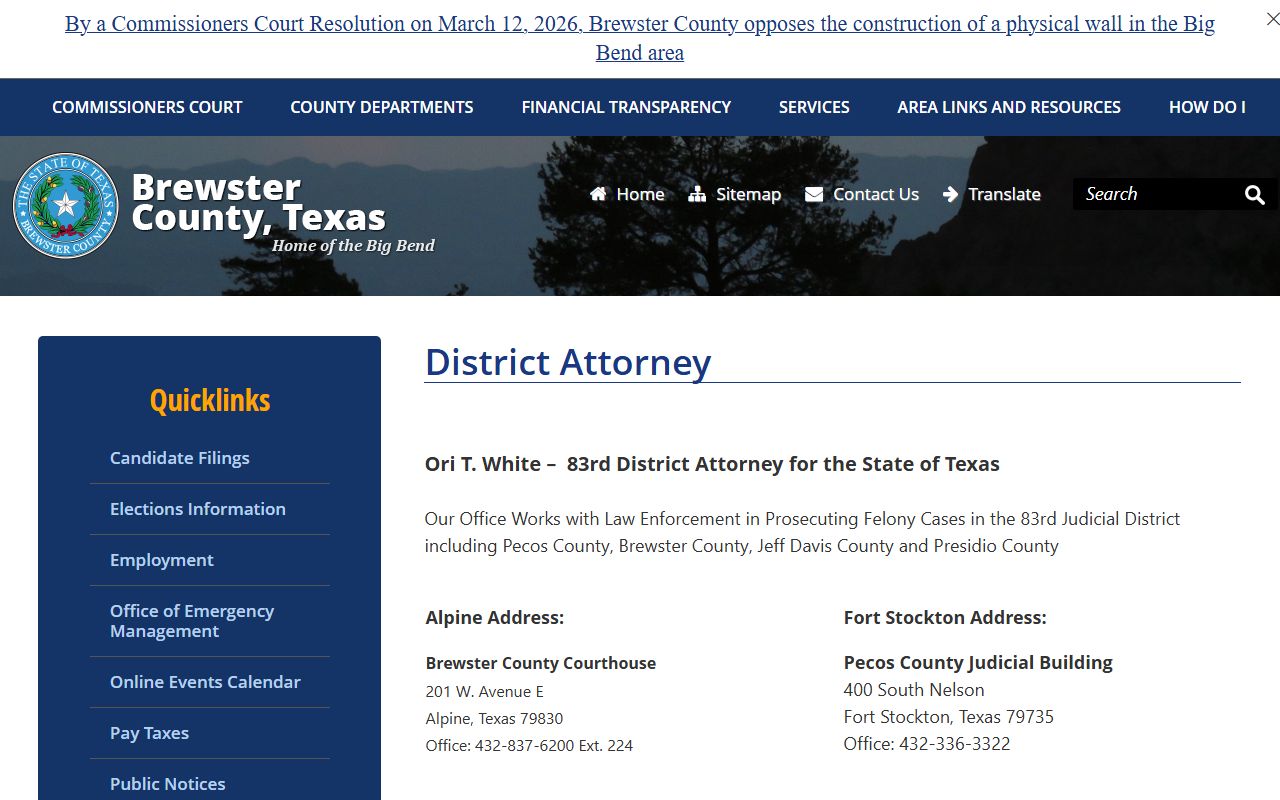
That prosecutor role is why court records after a jail arrest may not match the booking sheet word for word. The DA may file a different felony count, present a case to a grand jury, reduce the charge, dismiss a count, or add a count supported by the investigation.
| Document | Who Uses It | Common Role After Arrest | What to Check |
|---|---|---|---|
| Complaint | Officer, prosecutor, or complainant under oath | Can support an arrest, probable cause, or early case processing. | Name, alleged offense, date, sworn facts, and related warrant or cause number. |
| Information | Prosecutor | Used for some cases filed without grand-jury indictment where legally allowed. | Filed charge, offense level, prosecutor signature, and court assignment. |
| Indictment | Grand jury | Common felony charging instrument unless waived or otherwise authorized. | Count numbers, felony degree, statute language, and indictment date. |
Charge Status in Court Records After an Arrest
Charge status changes as a criminal case moves. A booking entry may remain a historical arrest record even when the court file later shows an amended charge, a reduced charge, a dismissal, or an indictment with different wording. That is why court records after a jail arrest should be read by status and date, not only by the first charge name listed at intake.
| Status | What It Means | Why It Matters |
|---|---|---|
| Pending | The filed case or count remains open and has not reached final disposition. | Calendar settings, bond conditions, and attorney appearances may still change. |
| Filed | A prosecutor has placed a charge into the court record through a charging instrument. | The court file, not the jail roster, becomes the better source for the formal accusation. |
| Amended or Reduced | The charge wording, degree, or count may have changed from an earlier filing or booking label. | A lower offense level or different count may affect bond, plea talks, and sentencing range. |
| Dismissed | The court has dismissed the charge or count. | A dismissal is not the same as automatic expunction. Record-clearing requires a separate legal process when available. |
| Indicted | A grand jury has returned a felony charging instrument. | The indictment may replace earlier complaint language and control the felony case path. |
| Disposed | The case or count has reached a final result, such as plea, verdict, dismissal, or sentence. | Disposition language is central when distinguishing a charge from a conviction. |
Bond, First Appearance, and Release After an Arrest
Texas Code of Criminal Procedure Article 15.17 requires an arrested person to be brought before a magistrate without unnecessary delay. At that first appearance, the magistrate gives warnings, explains rights, and addresses bail if the law allows release. Chapter 17 governs bail more broadly. Brewster County did not publish a jail bond-payment page, accepted payment list, or bond-desk hours in the research, so bond details should be confirmed directly with the jail or court before anyone travels with money or paperwork.
| Bond Type | How It Works | Brewster County Use Note |
|---|---|---|
| Cash Bond | The full bond amount is deposited as security for appearance. | Accepted methods and hours were not located online. Call 432-837-6200 Ext. 5541 before arrival. |
| Surety Bond | A licensed bail bond company posts bond for a fee or collateral. | Texas sureties are regulated under Occupations Code Chapter 1704 where applicable. |
| Personal or PR Bond | The defendant is released on a promise to appear, often with court conditions. | Set by a magistrate or court when legally allowed. |
| No-Bond Hold | Release is unavailable until the court or another agency clears the hold. | Can involve warrants, parole holds, ICE or federal holds, or a judicial order. |
Warrants That Lead to an Arrest
No official Brewster County sheriff active-warrant search, most-wanted list, or public warrant database was located. A warrant can still be the reason a person is booked into Brewster County Jail, but the warrant record and the jail booking record are separate. A warrant comes from court or magistrate authority. The booking is the jail intake event after a person is arrested or delivered into custody.
For warrant questions, use the sheriff or jail line at 432-837-6200 Ext. 5541, the District Clerk for district criminal case warrants at 432-837-6200 Ext. 203, justice or municipal courts for lower-level bench warrants, and Alpine Police Department for city police matters at 432-837-3486. The iDocket calendar can help with court settings and case numbers, but it is not a full warrant database.
Charge vs. Conviction in Court Records
A person can be arrested and charged without being convicted. Court records after a jail arrest may show accusations, hearings, and dismissals as well as convictions. The distinction matters for employment, licensing, housing, immigration, and personal decision-making, but public-record references are not consumer reports and should not be used for FCRA-covered screening.
| Charge | Conviction | |
|---|---|---|
| Stage | An accusation filed or pursued in court. | A final result after a guilty plea, no-contest plea, jury verdict, or court finding. |
| Proof | Based on probable cause, charging review, or grand-jury action depending on stage. | Requires the legal standard for conviction, including proof beyond a reasonable doubt at trial. |
| Record Meaning | Shows what was alleged, not what was proven. | Shows a legal finding or plea result and may carry sentence terms. |
| Can Change? | Yes. Charges may be amended, reduced, dismissed, or replaced. | Later relief may be limited and depends on Texas law and case facts. |
Sealed vs. Expunged Arrest and Court Records
Texas Code of Criminal Procedure Chapter 55A governs expunction for qualifying arrests and cases. Texas also has nondisclosure procedures that can limit public access in some circumstances. Expunction and nondisclosure are legal outcomes, not automatic results of release from jail. A dismissed charge, no-bill, acquittal, or completed program may create a possible path, but eligibility depends on the exact charge, disposition, timing, and criminal-history facts.
| Sealed or Nondisclosed | Expunged | |
|---|---|---|
| Public Visibility | Generally restricted from ordinary public disclosure. | Records are destroyed, deleted, or treated as not existing for many purposes when ordered. |
| Government Access | Some agencies may retain limited access depending on the order and statute. | Access is much narrower and controlled by the expunction order and Texas law. |
| Typical Trigger | Often tied to qualifying disposition and a nondisclosure order. | Often tied to qualifying arrests, acquittals, dismissals, pardons, or other Chapter 55A paths. |
| Practical Step | Review the court file and seek legal advice about nondisclosure eligibility. | Use the court process for expunction. A record request alone does not expunge a record. |
Public Access Limits for Court Records After Arrest
Texas Government Code Chapter 552 presumes public information is available unless it is confidential or excepted. Section 552.108 can protect some law-enforcement, corrections, and prosecutor records when release would interfere with investigation or prosecution, but basic information about an arrested person, an arrest, or a crime remains central to public access analysis. Juvenile records, sealed records, expunged matters, active investigations, victim information, medical information, and confidential identifiers may be withheld or redacted.
For a filed district criminal case, ask for the existing record with enough detail to identify it: full name, date of birth if known, arrest or booking date, case number, charge, and the exact document needed. Filed-document searching may require iDocket/Ruby registration or direct clerk access for older and complete records.
The iDocket Ruby registration page is linked from the District Clerk page for filed-document search access.
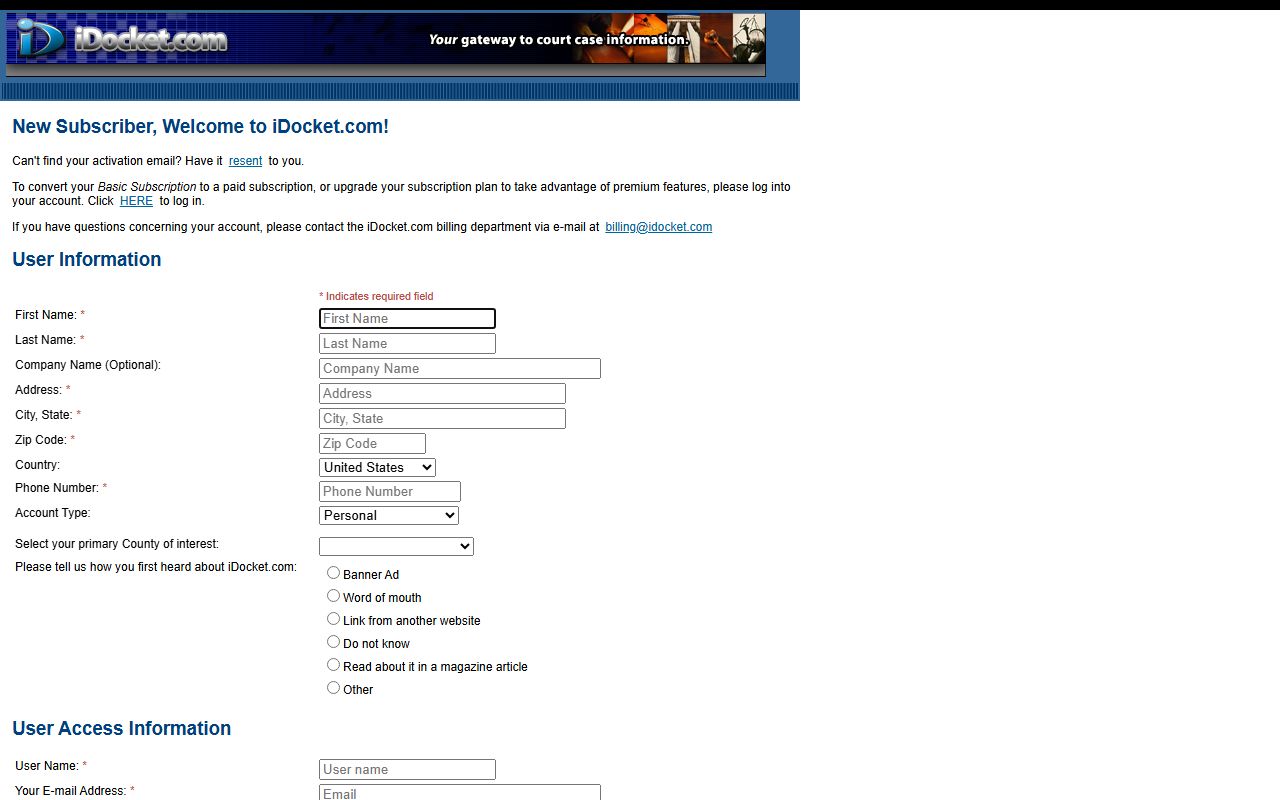
Ruby registration is separate from the free calendar view. Use it only when the needed task is filed-document research rather than confirming a hearing setting.
Background Check Considerations
Court records after an arrest can be incomplete if a case is pending, restricted, misidentified, or still moving between jail, prosecutor, and clerk systems. A name-only match is especially risky in public-record searches. Confirm identifiers and final dispositions with the originating court before relying on a result.
Important: This site is not a consumer reporting agency under the FCRA, and its information may not be used for credit, employment, housing, insurance, or similar screening.
Public Record Search
Sponsored Results